


Leopold Aschebrenner’s situational awareness has just filed its positions as of the end of June, and almost nobody is talking about it. The silence is quite the opposite of a few months ago, when every SEC filing sparked threads, screenshots and copy-trading.
People can say Leopold lost big time when he was “forced” to sell the bulk of his public book to Citadel in July. But as mentioned previously, I believe that while the event was unfortunate it does not prove the picks-and-shovels bet is wrong. In fact, the largest holdings disclosed in Q1 bounced back over 20% a day after the transaction. And Forbes reported a 439% gain on SA’s held positions for the H1 2026.
So while Leopold lost his public-market star power for now, I want to take a close look at his latest filings. Not to follow the trade, but to use it as a lens to review the AI-infrastructure thesis. Let's start.
AUM continued to grow, but the structure of the book changed
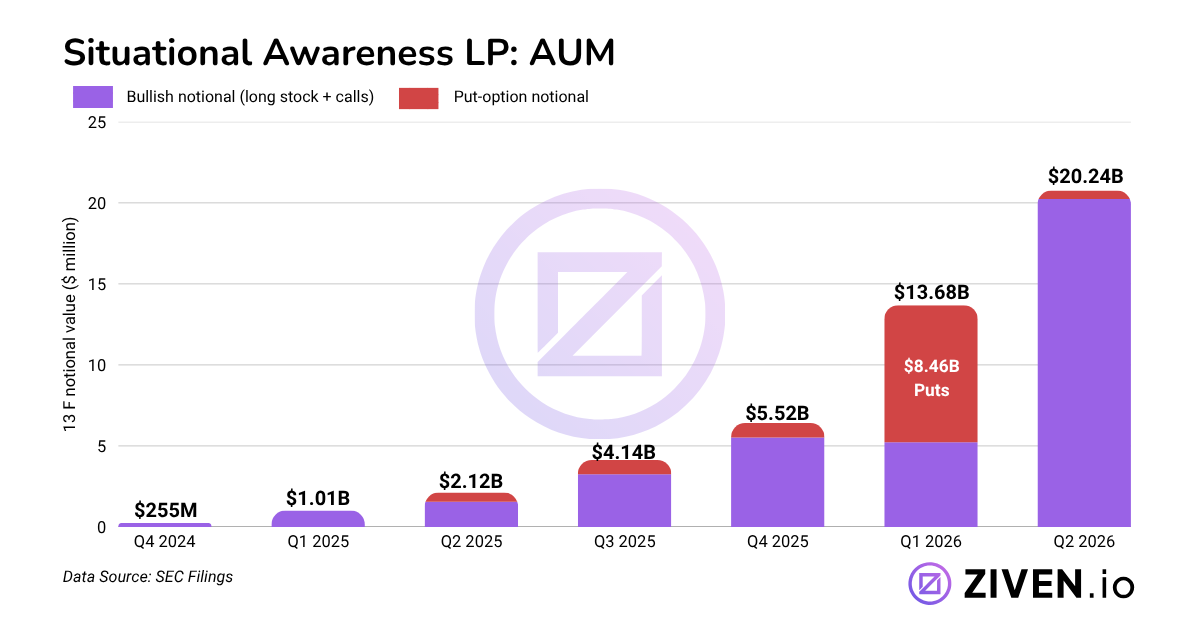
At the end of Q2, total assets under management (notional value) rose to $20.24B, a 48% increase from the previous quarter. But by stripping out the put options, the book value of long positions expanded from $3.86B to $20.17B, which is ~423% growth over 3 months. In other words, Awareness did not merely grow; it aggressively reduced options leverage and concentrated capital on fewer selected bets.
The short book disappeared
In Q1, the notional value of the fund’s put options not only occupied the top five spots in its holdings but also accounted for $8.46B of its $13.68B AUM. By the end of June, that protective short leg had been almost entirely unwound, leaving only a $5.2 million Infosys put.
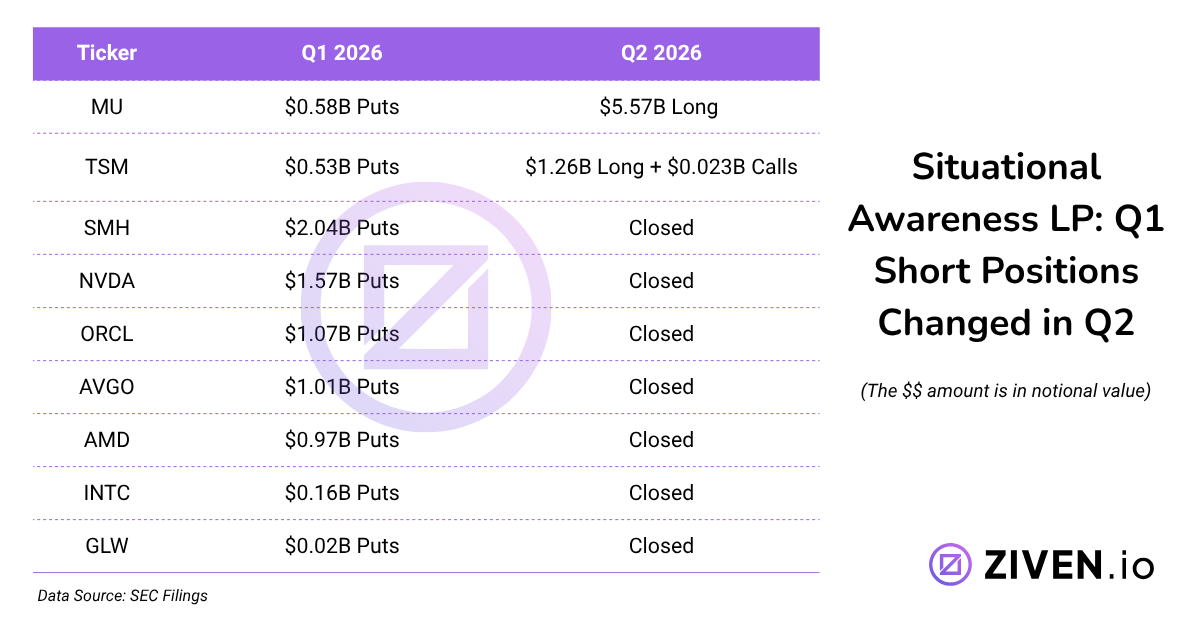
Leopold did not roll the hedges or shrink previous shorts. Instead, he removed them entirely while scaling the long side five-fold.
Positions at the end of June
The largest reported holdings at quarter-end tell the new story clearly.
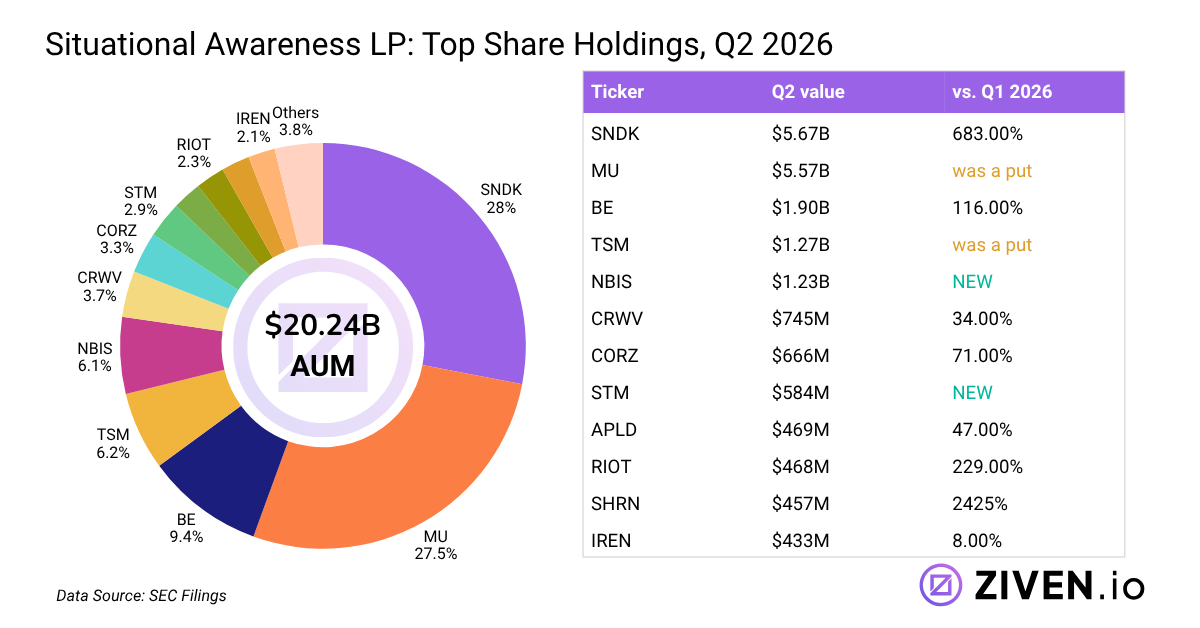
Memory alone (SNDK + MU) now accounts for more than half the portfolio. The previous quarter’s emphasis on power shells and compute capacity has been subordinated.
Share counts reveal where the real money went
Because market value can be inflated by price moves, let’s compare the share counts changes.
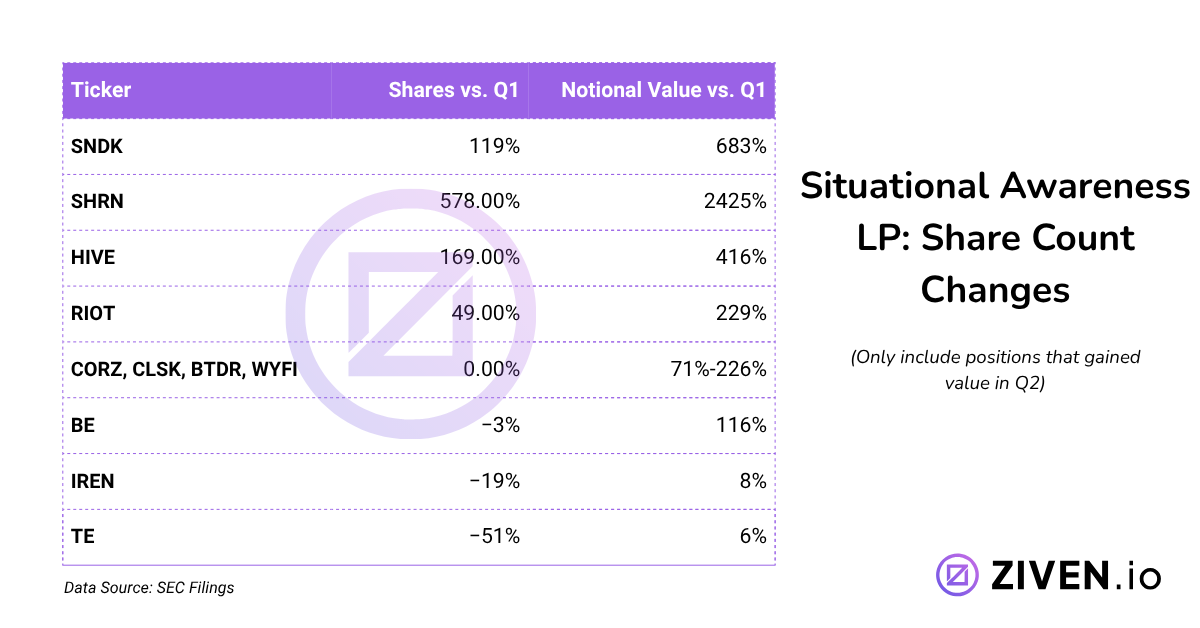
Leopold didn’t add a single share to Core Scientific, CleanSpark, Bitdeer, or WhiteFiber. He even trimmed Bloom Energy, IREN, and T1 Energy. While book values of these positions were higher, the number of shares shows no fresh capital injection into the same ticker names. The genuine new money flowed into computer memory.
The sector mix makes the pivot explicit:
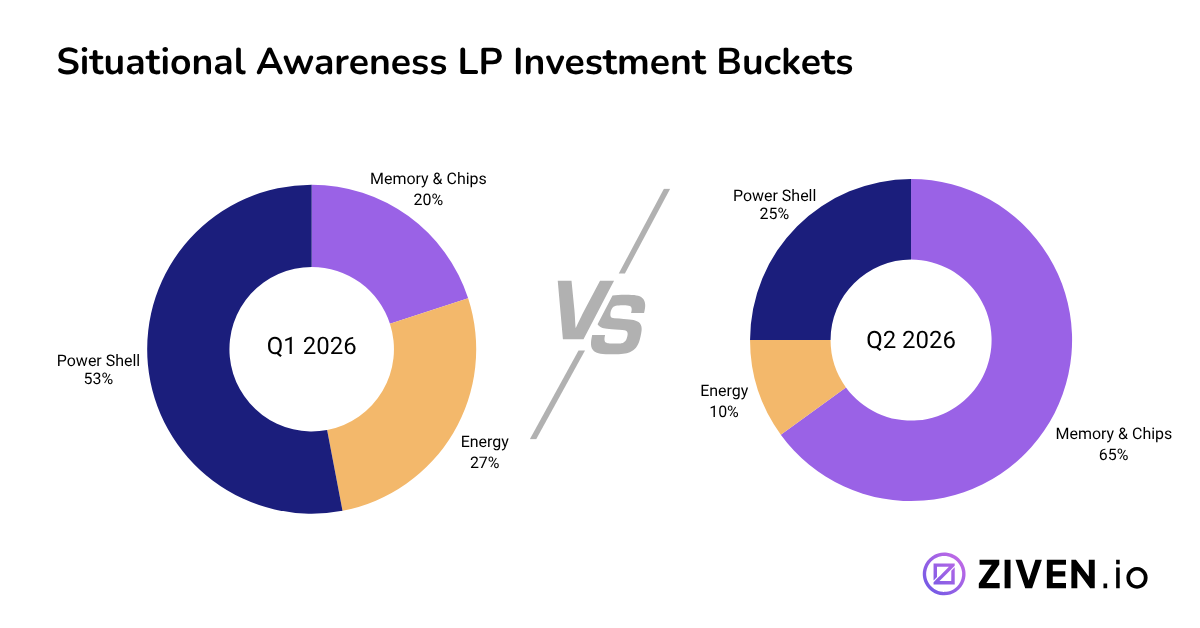
The move into Micron and Sandisk refines Leopold’s approach towards the picks-and-shovels bet. HBM and NAND are genuine bottlenecks. At the same time it swaps one set of risks for another. Memory remains a deeply cyclical industry. The semiconductor memory demand historically has coexisted with oversupply, falling average selling prices, and inventory corrections. By making memory more than half the book, Situational Awareness exchanged operational risks around power, permitting, and neocloud customer concentration for semiconductor pricing power and capex-cycle risk.
Final Thoughts
Genius or not, perception is subjective and temporary. What the filings show is consistent: every material line in both quarters points to physical infrastructure. No hyperscalers, and by the end of June no NVIDIA. Through a 439% run, a clear thesis shift, and July blow-up, Aschenbrenner never bought the companies that dominate the AI headlines. He kept buying the suppliers, and in Q2 he shifted focus from GPU power shells to the memory makers those GPUs run on.
The shift is the part worth studying, Treating the holdings as a shopping list misses the point. I'm asking myself what are the recent development in memory bandwidth? Have I miss anything material there? So yes, next time I may share my own notes on computer memory. Or if you are a buy/sell side analyst covering the space, I'd welcome your research/views.
Oh, a final note: Situational Awareness kept its private book through the liquidation. Anthropic (reportedly ~$5 billion), Fluidstack and other names do not appear in a 13F, yet all of them continue to attract strong investor interest should they ever get listed. For that reason alone the firm still holds a sizable and coherent thesis, even if the public-market star power has faded for now.
Disclaimer: The views expressed in this article are my own and are based on publicly available information. This content is intended for informational purposes only and should not be construed as investment advice. Readers are encouraged to conduct their own research before making any investment decisions. Past performance is not indicative of future results.


