


If you've invested in AI-infra equities, you'll know the feeling: announcements of multi-billion-dollar hyperscaler deals that would have re-rated the stock overnight one year ago can barely move the price now. The market got more skeptical, but also smarter. It stopped paying for announcements and started asking the hard questions: What did the balance sheet give up to build this? Is there any economic return left for shareholders once you net out the debt and the dilution... That's why we built the colocation valuation simulator a few months back, so you can take a deal apart past the headline numbers and see what it's actually worth.
But judging a deal is only half the job, the other half is timing. I didn't connect the two until very recently. Something clicked while I was watching a video by a YouTuber who spent a decade as an investment banking professional. He laid out his framework of stock investing in a two-hour video. Obviously there is no single golden standard framework for investing, but this video surprisingly answered a question that bothers many people: why a stock can sit deep in the red, along with nearly everyone else in its sector, while the company's fundamentals are exactly what they were a week ago.
In short, the fundamentals tell us whether its worth owning, and the macro tells whether it's a good time to buy. So the following is my first attempt at turning that second half into something readable instead of a gut feeling. Let me walk you through.
Start from the top: what does the money cost
Energy-powered shells are a leveraged bet on cheap capital being available. These companies spend billions before they earn a predictable dollar, and they fund the gap with convertibles notes, high-yield debt , and new shares.
So this comes back to 3 things: Is money getting cheaper? Can the Fed even cut?And if it does, does that money actually reach companies like these?
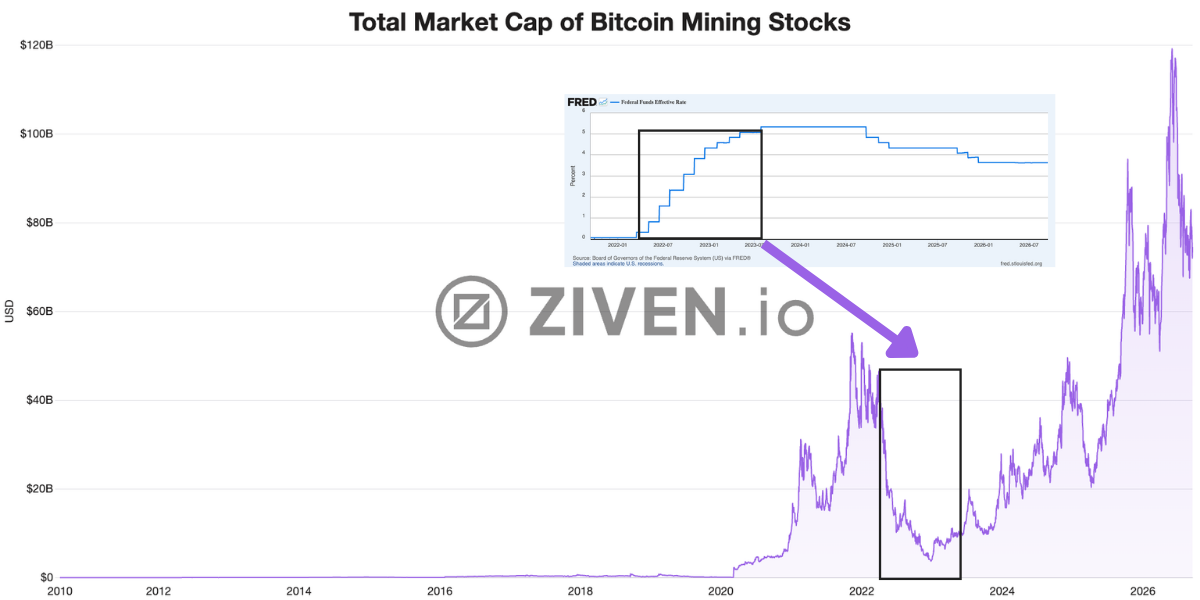
Rates are the obvious piece. The policy rate is the price of money. When the Fed cuts, borrowing gets cheaper. The quieter effect is the one that matters more for power-shelled companies: cash arriving in 2028 or 2029 is worth more today. A lot of these stocks are priced on buildings that are not earning yet. That's why a hike hit them so hard.
The balance sheet is the other piece. If the Fed is buying bonds, cash is going into the system. If it is letting bonds roll off, cash is coming out. Neither piece means much alone. A cut into a shrinking balance sheet is only half helpful. Cuts plus more liquidity is the environment where these names are most likely to be funded no matter how early-stage they look.
If that sounds vague, 2022 is a clear proof. The Fed hiked aggressively and drained at the same time. Miners still lost 80 to 90 percent of their value in a year when most of them grew hash rate every single month. Operations were fine, but stocks were not. Looking back, all of price movement makes sense from the cost of money.
However, the Fed does not cut because a data-center pipeline needs it. Inflation decides whether they are allowed to.
The Fed only moves if inflation lets it
The bull case quietly assumes rates are coming down. That only happens if inflation cooperates. The Fed’s target is still 2 percent. Until the data actually leans that way, the cuts already priced in do not arrive.
That's why watching CPI helps. Though they can't tell us much about companies, but they can indicate whether cheaper money is even on the table.
The trap is the head fake. A soft jobs number gets people excited about cuts on a Friday. A hot inflation print takes those cuts off the table two weeks later. In other words, rallies built on “cuts are coming” are not real convictions and can easily retreat the price reaction.
Even if the Fed does cut, that is not the same thing as a half-built campus getting financed.
Cheap money still has to reach companies
For that, watch high-yield credit spreads: the extra interest a risker borrower pays over the US government. If you want to know whether the next convert or project loan still works, this is the number to look at. When the extra interest is under about 3 percent, the window is wide open and companies can raise billions on friendly terms; When it grinds toward 5 percent, our kind of issuer starts to feel it, well before anyone is talking about a credit crisis; By the time spreads look like 2008, you are late.
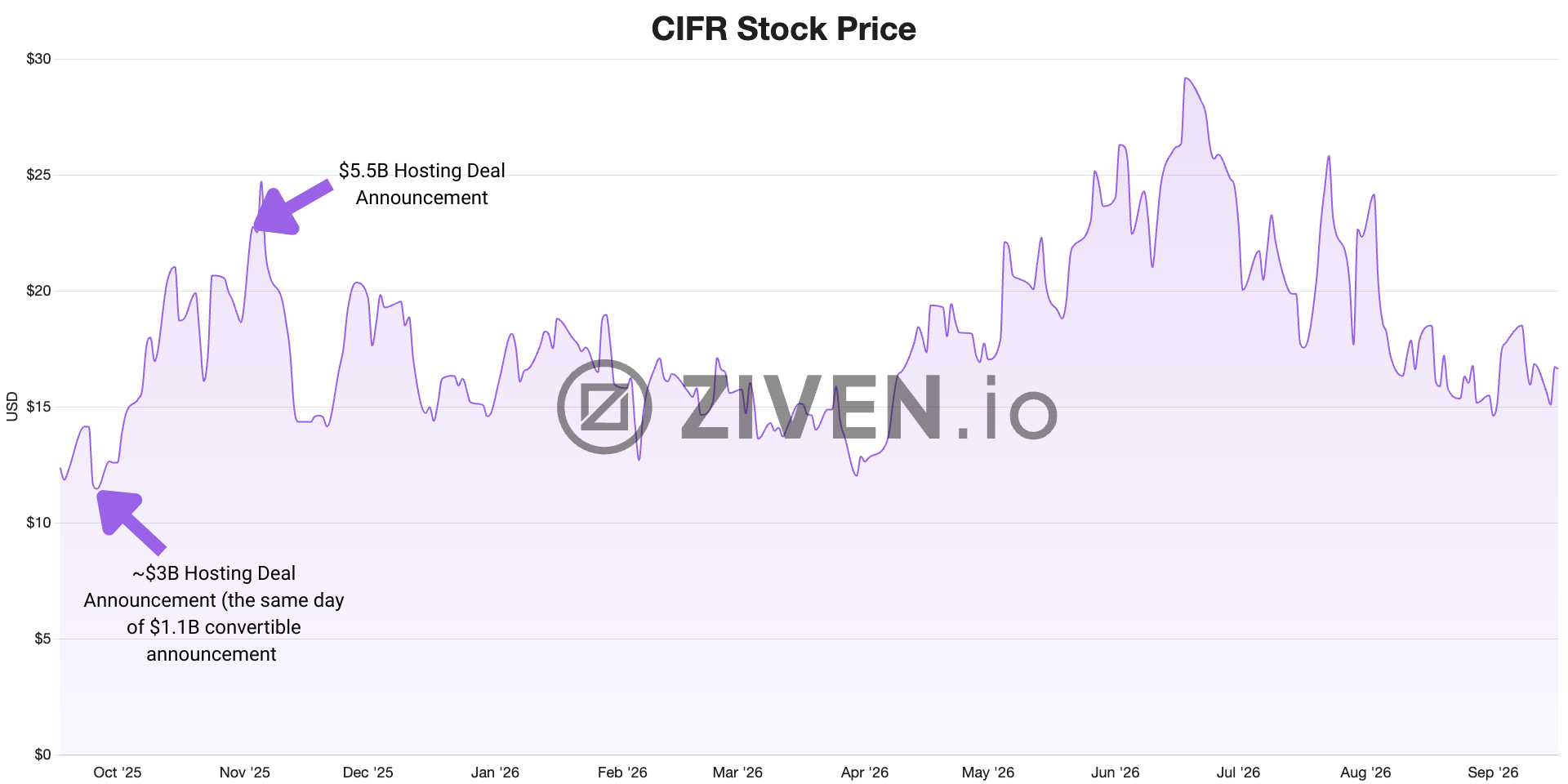
The sector’s own deals are even more direct. Watch the coupon on the convertibles and watch the stock the day it prices. Take Cipher as an example. In September the $1.1 billion convertible notes sat next to a $3 billion HPC deal, and the stock went sideways while people did the dilution math. About a month later AWS showed up with $5.5 billion and the stock jumped 19 percent in a day. One was about funding. One was about the pipeline. Both mattered with a month apart, and the press releases alone would have taught you neither.
If money is cheap, the Fed can ease and the credit is still open, the only question left is about the entry: are these stocks actually on sale?
Then fear sets the price
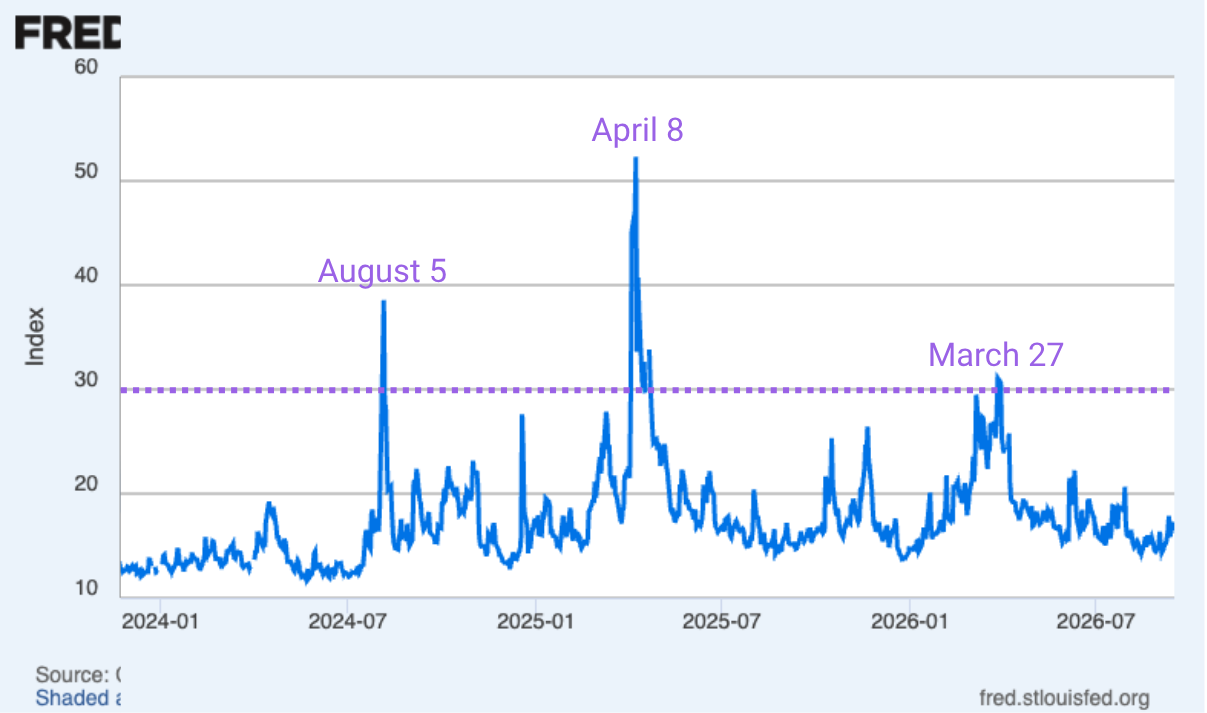
Take note from the YoutTuber, by using the VIX the opposite way most people talk about it. Reading above 30 usually means someone is being forced to sell what they can. That is when high-beta names like AI infras get marked down while nothing in the business changes. A VIX in the mid-teens means there is no discount. A good story is not enough to add there.
Margin debt is the other positioning tell. FINRA publishes it late, so year-over-year change matters more. Up 30 or 40 percent means the borrowed money has not been shaken out. Falling for months means weak hands are already gone. It arrives on a lag and moves with sell-offs rather than ahead of them, so it's context for the VIX signal, never a trigger on its own.
When the whole chain lines up, you can recognize it. April 2025 and March 2026 looked the same: VIX above 30, the Fed done threatening hikes, margin debt coming down, and the sector's leaders still beating estimates straight through the panic. Nothing about the businesses changed in those weeks. The stocks just got cheaper.
The chain does more than time entries. It also tells you which names the moment will carry: easy money lifts the speculative names; Tighter money is harder on them than the ones that already have funding and contracted revenue. They just get marked down.
Where the chain stands this week
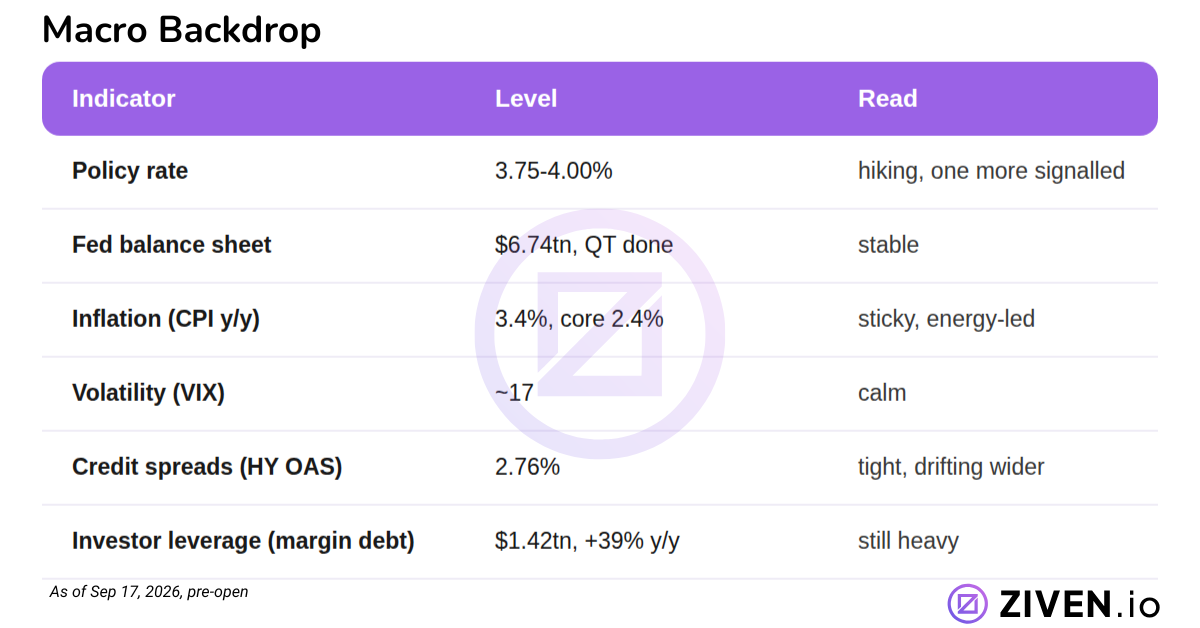
The Fed raised rates a quarter point on Wednesday, to 3.75-4 percent. Everyone on the committee went along with it. They still think inflation is too high. They are keeping the balance sheet ample, not adding to it. So money got more expensive, and there is no extra cash coming into the system to offset that.
The inflation print is why they hiked. Core CPI came down to 2.4 percent in August. That is the lowest since early 2021. Headline stayed at 3.4 percent because energy jumped. The Fed treated that as enough. Cuts are not the story right now.
Credit is the one thing that still looks fine. High-yield spreads are around 2.7 percent. That is cheap, and it is why these companies can still get deals done. The stocks themselves are not cheap. VIX finished near 18. Margin debt dropped 5.7 percent in July, but it's still up about 37 percent from a year ago. A lot of borrowed money is still out there.
You probably noticed a few of the AI infras names went up despite the hike. The rest of the market did not. That does not mean the framework is wrong. The hike was expected, spreads barely moved, and the inflation problem is energy. If you own generation or a locked-in power contract, that same problem helps you. It also keeps the Fed from cutting. The market went with the power story this week. Just don’t forget the other half: tighter policy, leverage that has not been cleaned out, and no fear in the price. That kind of rally only lasts if spreads stay quiet.
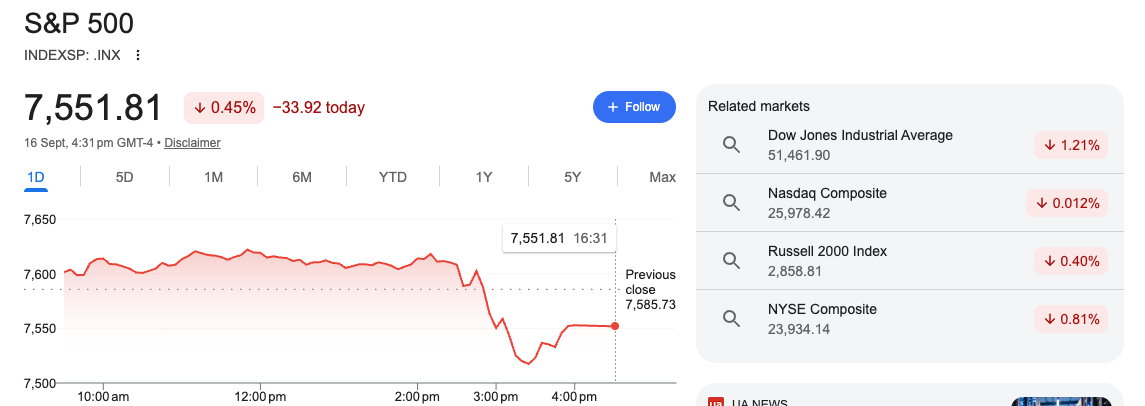
The window to raise money is still open. The direction of money is not helping. Inflation is in the way, and these stocks are not on sale. I am not adding here.
Final Thoughts
For the last couple of months, I simply got tired of the wires. Another colocation deal, another capacity target, each told me a little less than the one before. And the market has already learned to shrug at the headline. I was also watching a dozen tickers closely enough that it was wearing me out. Worse, I missed the thing sitting above all of them: the tide that lifts or drops the whole group at once.
So starting next week, this section stays. Each weekly newsletter I will run through the same chain, from the cost of money down to fear and positioning, before we get into anything else. It will not match everyone’s process. That is fine. If you take one thing from this, take this: fundamentals still decide what is worth owning. Macro decides whether it deserves new money for the time being.
Disclaimer: The views expressed in this article are my own and are based on publicly available information. This content is intended for informational purposes only and should not be construed as investment advice. Readers are encouraged to conduct their own research before making any investment decisions. Past performance is not indicative of future results.


